Geen categorie
Meet Timon Udo
Get to know more about one of our lab members, Timon Udo! Timon is a PhD-student at ALLP, focusing on the influence of the use of rapid testing at the crime scene on the behaviour of crime scene investigators, supervised by Jasper van der Kemp and Christianne de Poot. We asked him a few questions.
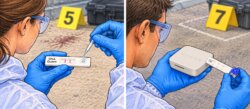
What is your project about?
My PhD research examines how rapid forensic tests influence decision-making at crime scenes. As part of the Criminal Investigation DX (CIDX, www.project-cidx.nl/) project, new technologies are being developed that allow biological traces to be analysed directly at the crime scene. While these technologies can provide investigators with information much sooner than traditional laboratory analyses, they also raise important questions about how and when these rapid technologies should be used. My research focuses on understanding those effects and developing decision-support tools for the effective and efficient use of these rapid tests.
What are you currently working on?
I am currently conducting an experiment in a virtual crime scene environment that I developed for this project. Crime scene investigators can examine a virtual crime scene while we record their actions. Using this environment, we study how a rapid test that can indicate whether a sample contains sufficient DNA for DNA-profiling at a laboratory influences crime scene decision-making. We are currently collecting data for this experiment, so if anyone knows crime scene investigators that are willing to participate, feel free to reach out!
What made you get into this topic?
I have always been fascinated by the factors that shape decision-making and behaviour. This fascination only grew stronger during my participation in Project Gerede Twijfel, where students, supervised by teachers and experts, examine a case in which the convicted individual claims to be innocent. That project continuously demonstrates how expectations and assumptions can influence the criminal investigation, even in the so-called “hard sciences”. This is particularly interesting in the examination of crime scenes as they are inherently ambiguous environments in which early decisions determine which traces are available for further analysis and what conclusions can be drawn from those analyses. A research project that examines this in the context of new technologies and with a strong connection to practice was therefore a perfect fit.
What do you want to be when you grow up?
Ever since I was young, I have wanted to join the police. Although my view of the tasks and challenges of policing have matured, this never changed. I would especially like to work as an investigative psychologist as this is a very interesting role within the police that would allow me to utilize what I have learned and researched to make a positive impact in criminal investigations. If possible, I would love to combine this with continuing academic research so that practice can inform my research, and research can inform my practice.